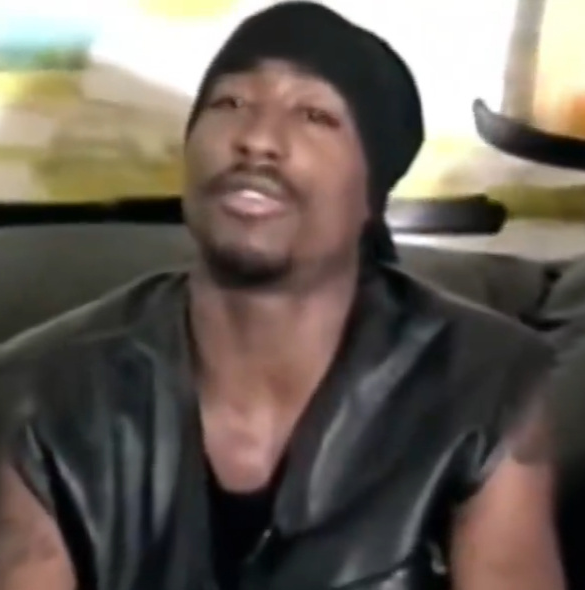
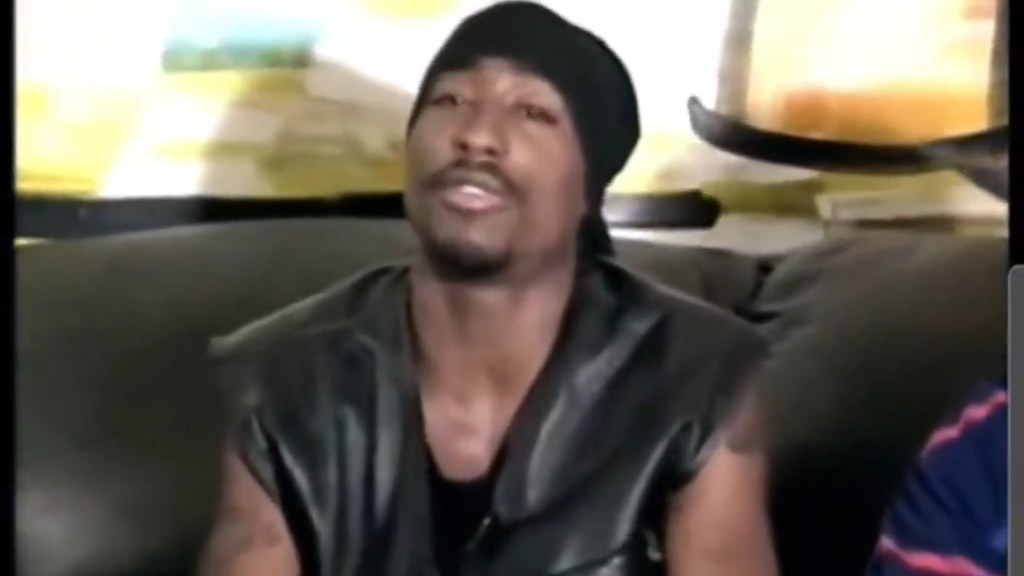
In the early ’90s, long before hip-hop went mainstream, a young 2Pac found himself in an unlikely standoff with the highest levels of the U.S. government.
Caught on camera during a raw, unguarded interview from that era, Tupac isn’t defensive or polished for media consumption—he is incredulous, sharp, and completely unbothered by the target painted on his back.
Looking back at the footage, what stands out most isn’t just the intensity of the political heat he was taking, but how effortlessly he flipped that hostility into fuel. Facing pressure from Washington, nervous record executives, and skeptical retail gatekeepers, Tupac didn’t retreat. Instead, he used the establishment’s panic to sharpen his message and birth the next phase of his career: Thug Life.
In the Crosshairs of the Vice President
When the interviewer brings up the wave of censorship aimed at his music, Tupac wastes no time correcting the framing. The Vice President of the United States—Dan Quayle, who famously condemned Tupac’s 1991 debut album 2Pacalypse Now and called for it to be pulled from stores—hadn’t merely “tried” to come at him. He had swung with the full weight of his office.
For a young Black artist fresh out of the hood, the sheer absurdity of the moment wasn’t lost on him. “The vice president talked about me… he know me. He want my shit up off the shelf,” Tupac says, marveling at the reach of his own voice.
Yet his astonishment quickly gives way to a pointed critique of cultural double standards. Tupac immediately calls out the selective outrage of Washington’s moral crusaders, questioning why heavy metal and rock bands like Megadeth—acts whose catalogs were steeped in dark, violent imagery—escaped similar White House condemnation. To Tupac, the answer was obvious. Mainstream rock was treated as harmless rebellion, while his music was viewed as an active threat because it spoke directly to marginalized communities about systemic oppression and fighting back.
Rather than intimidating him, the political backlash served as ultimate validation. If the Vice President was demanding his records be pulled, it meant the message was landing. “Thug Life is my revenge on all that,” Tupac declares, framing his upcoming group and philosophical movement not as a detour, but as a direct, defiant counterpunch to political censorship.
Record Label Panic and “Two-Inch Tape”
Washington wasn’t the only front where Tupac was fighting for artistic survival. In 1992, the music industry was walking on eggshells—most notably seen when Time Warner buckled under political and police union pressure over Ice-T and Body Count’s controversial track “Cop Killer.” Asked if his own record company had similarly folded under the heat, Tupac paints a vivid picture of corporate cowardice.
“My record company tripped, fell down, bounced, did triple somersaults, got up, fell two more times, got up, tripped, fell, rolled over in the gutter, and tripped six more times,” he fires back.
Behind closed doors, executives were scrambling to sanitize and stifle his output, desperate to avoid becoming the next political punching bag. Still, Tupac saw a fatal flaw in their attempts to muzzle him. You can pull albums from chain stores and stall release dates, he argued, but you can’t erase an idea once it’s been captured. As long as studios still had “two-inch tape”—the analog standard of the era—and artists willing to speak unfiltered truth, corporate gatekeepers could never fully silence the streets.
Bypassing the Gatekeepers
Perhaps the most revealing moment of the interview happens when the conversation briefly breaks away into candid banter with his crew in the room. Playfully checking the energy around him, Tupac asks, “Is we going platinum or what?”
It’s a lighthearted exchange, yet it underscores the exact reason he refused to bow to corporate or political threats: Tupac didn’t believe he needed their shelves to survive. In his mind, authentic street music operated on the same undeniable laws of supply and demand as any underground economy. Even if every major retailer blacklisted his albums, he was confident he could sell tapes straight out of the trunk of his car and still move platinum numbers. When the music reflects raw, unvarnished reality, the audience finds it—with or without industry permission.
As the interview pivots toward the relentless media scrutiny surrounding his personal controversies, the larger picture comes into focus. By attempting to make an example out of Tupac Shakur, politicians and nervous executives inadvertently handed him a megaphone. They wanted him off the shelves and out of the public consciousness; instead, they helped forge an icon who turned every attempt at censorship into proof of his power.