Sports and Entertainment Journalist Jessica “Noonie” Noble talks to C-Note, aka King of Prison Hip Hop, on 2Pac’s posthumous bootleg releases.
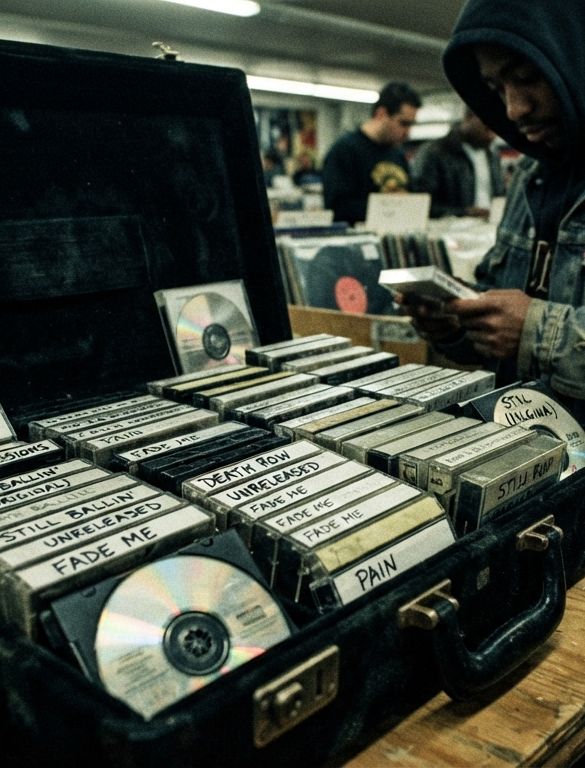
In the late 1990s, if you wanted to hear the real Tupac Shakur, you didn’t go to a record store. You went to a swap meet, a flea market, or a shady corner bodega. You looked for the guy with the plastic milk crates or the velvet-lined briefcase filled with unmarked, CD-R discs and multi-generation cassette tapes.
On those bootlegs, scrawled in black Sharpie, were cryptic track titles like “W-W-I-I,” “Tongue Kissin’,” “Fade Me,” and “Reincarnation.” To the uninitiated, they looked like garbage. To hip-hop purists and Tupac disciples, they were holy grails.
Before Amaru Entertainment and Interscope Records spent decades sanitizing, remixing, and commercializing the vast archive left behind after September 13, 1996, there existed a sprawling, multimillion-dollar black market empire. This underground network was fueled entirely by stolen studio DAT tapes. Long before the internet made leaking music a frictionless act of a few clicks, the 2Pac bootleg catalog was a gritty, dangerous, and raw subculture that captured a genius at his most unfiltered—and his most paranoid.
The Can Am Leak Epidemic: How the Vault Was Stripped Bare
To understand the sheer volume of Tupac’s bootleg catalog, you have to understand the manic pacing of his final year. Upon his release from Clinton Correctional Facility in October 1995, courtesy of a Death Row Records bail bond, Tupac lived in the studio. His primary sanctuary was Can Am Studios in Tarzana, California.
Tupac didn’t write songs; he laid down verses like an assembly line worker possessed by his own mortality. He would finish a track, order the engineer to burn a rough mix to a cassette or DAT tape so he could listen to it in his car, and immediately start the next beat.
Because of this chaotic, hyper-prolific workflow, security around his intellectual property was practically nonexistent. Engineers, interns, studio guests, hangers-on, and disloyal associates all had access to these rough mixes. When Tupac was killed in Las Vegas, the immediate power vacuum at Death Row Records turned into an open-season pillaging of the vault.
Master tapes stayed locked up, but hundreds of rough-mix DATs and cassettes walked right out the front door of Can Am. Within months, these tapes fell into the hands of bootleg cartels spanning from Los Angeles to New York, and across the Atlantic to Europe. The streets were flooded with music that Suge Knight and Afeni Shakur didn’t even know existed yet.
Case Study: “Breathin’” vs. The 2001 Cleansing
There is no better case study for how the record labels eventually “cleansed” Tupac’s legacy than the evolution of the track “Breathin’.”
On January 31, 1996, Tupac walked into Can Am and recorded what bootleggers initially labeled “W-W-I-I” (World War 2). Produced by his frequent collaborator Johnny “J” Jackson, the original unreleased version was a masterclass in West Coast g-funk melancholia. Johnny “J” built the entire instrumental around a gorgeous, prominent sample of “Summer Breeze” by the Isley Brothers.
The juxtaposition was haunting: Tupac delivering a visceral, panic-induced sermon on survival over a smooth, nostalgic soul sample. He rapped alongside the Outlawz, but the bootleg also featured an incredibly raw, venomous verse from West Coast lyricist Sylk-E. Fyne, alongside contributions from Yaki Kadafi and Diamond.
When the track was officially stripped from the black market and placed on the 4× Platinum 2001 posthumous album Until the End of Time, it was unrecognizable to those who owned the bootleg.
+----------------------------+-----------------------------------+-----------------------------------+

| Feature                    | The Underground Bootleg ("W-W-I-I") | The Retail Release ("Breathin'")   |
+----------------------------+-----------------------------------+-----------------------------------+

| Production                 | Johnny "J" Jackson                | L.T. Hutton (Remix)               |
| Instrumentation            | Smooth G-Funk, Isley Brothers     | Tense, stripped-back, aggressive  |
| Guest Verses               | Sylk-E. Fyne, Outlawz, Kadafi     | Outlawz only                      |
| Sonic Tone                 | Haunting, soulful paranoia        | Rigid, digitized combat music     |
+----------------------------+-----------------------------------+-----------------------------------+
To clear the Isley Brothers sample would have cost a fortune, and the label wanted a modernized, radio-friendly sound for the turn of the millennium. The retail version stripped out Johnny “J”‘s bounce, erased Sylk-E. Fyne’s verse entirely, and replaced the track with a colder, digitized beat. While the official version succeeded commercially, it lacked the warm, analog tragedy of the 1996 original. The soul of the song had been scrubbed away.
The Currency of Paranoia
What made these bootlegs so captivating was that they served as an uncensored audio diary of a man who knew his time was running out. On the official retail albums, tracks were sequenced to create a narrative flow. On the bootlegs, you heard the raw, psychological weight of 1996 in real time.
In the unedited studio takes of tracks like “Fame,” “Hell 4 a Hustler,” and the original “Thug Nature,” you hear Tupac talking to the engineers between takes. You hear the blunt rawness of his voice, un-layered and un-mastered.
The central thesis of his bootleg catalog was absolute, terrifying paranoia. When Tupac screamed on the original “Breathin'” hook—“Who’ll be the last motherfucker breathin’?”—it wasn’t just a tough rap lyric. It was a literal question he was parsing through every single day. Lines like “Woke up with fifty enemies plottin’ my death” and constant references to sleeping in his bulletproof vest hit differently on a grainy tape dub than they did on a pristine, corporate-distributed compact disc. The bootlegs didn’t hide his fear behind glossy production; they amplified it.
The Ghost in the Machine
The irony of the 2Pac bootleg empire is that it ultimately preserved his legacy better than the record labels did. Throughout the late ’90s and early 2000s, posthumous albums like Better Dayz, Until the End of Time, and Pac’s Life faced heavy criticism for inserting contemporary pop and rap stars onto Tupac’s tracks—artists he had never met, and in some cases, artists he likely would have feuded with.
The bootlegs remained a time capsule. They proved that before the corporate cleansing, Tupac didn’t need acoustic guitars, EDM synths, or trendy modern features to sound timeless. He just needed a Johnny “J” or Hurt-M-Badd baseline, his Outlawz brothers riding shotgun, and a microphone to capture his final, breathless moments.
The official albums gave Tupac plaques, but the bootlegs gave him immortality. They remind us that the truest version of hip-hop’s most tragic icon will always belong to the streets, preserved forever in the hiss and crackle of stolen audio.
1996 Raw Original Version of Breathin’
Jessica “Noonie” Noble: Why did you want to write about 2Pac’s bootleg recordings?
Donald “C-Note” Hooker (King of Prison Hip Hop): I thought it was important for the community [Hip-Hop] and for the fans to be aware, they were bamboozled. These sanitized label released versions of 2Pac, wasn’t 2Pac.
Jessica: I grew up on 2Pac, what do you mean the studio albums were not 2Pac?
C-Note: They weren’t the raw, unfiltered 2Pac. The most egregious of these filtered studio versions was Why U Turn On Me [click link to hear original version]. 2Pac is accredited for producing the original version; and it sampled the Gap Band’s Burn Rubber on Me (Why You Wanna Hurt Me). The studio released version, was a very slow tempo, and boring ass track. The original dis-track unloaded on Wendy Williams, a verbal assault unmatched; while the studio version never mentions her name.
Jessica: I was 9-years-old when 2Pac died, so I am more familiar with these studio released versions. So why are you so passionate for us who grew up on the studio versions to know about these demo sessions?
C-Note: It all stems from 2Pac’s original bootleg, Killuminati. After his death, Death Row Records released an album version, now known as The Don Killumanti: The 7 Day Theory. While I have heard 2Pac say this in his own words, the only source I could find to confirm this history was from a Crack magazine article, “Under Covers: The untold story behind Tupac’s haunting The 7 Day Theory artwork.” According to the album cover’s visual artist Ronald “Riskie” Brent:
The 7 Day Theory was originally going to be this underground album; Pac predicted the rise of mixtapes and was only going to sell it only at the mom-and-pop stores. It only turned into a commercial album after he died.
Jessica: How do you know about this, several months after 2Pac was murdered, you spent the last 30 years in prison?
C-Note: That’s because the streets and prisons are one in the same. All subsequent bootlegs after the studio release of The 7 Day Theory, were titled Machiavelli 1, 2, 3, and so on… The final track on 7 Day Theory is titled, “Against All Odds.” It’s chorus, “Hopin’ my true motherfuckers know / This be the realest shit I ever wrote / Against all odds / Up in the studio gettin’ blow / To the truest shit I ever spoke.” The posthumous and commercially successful 2Pac albums, were dummy downed versions by record label executive Gatekeepers to our culture. They criminally hid from America and the world writ large, our collective struggle, expressed raw and unfiltered by Hip Hop’s most clear poetic and political genius.
Jessica: What about Diamond?
C-Note: That’s a great case in point. The chauvinism of 1990s Hip Hip prevented many female rappers from getting their own projects completed and out into the marketplace. Diamond’s 16-bars were axed from the studio version of Breathin. And here’s why. Many romanticize about the collective Black power, if the Crips and Bloods would unite. But an even more sinister threat to the dominant culture, and the uplifting of our people, would be the coming together of the Black man, and the Black woman. Diamond’s raw lyrics, coupled with Pac’s and the Outlaws, makes Wakanda’s utopian dream look like a Third World country.
Conclusion: Before the Label Cleansed Them…
ends where it must: with the reminder that the real 2Pac never needed corporate polish to endure. The bootlegs—those hiss-filled, Sharpie-scrawled, multi-generation tapes that once moved through swap meets and prison yards—captured a man racing against time, paranoia, and mortality in real time. They kept the soul samples, the erased verses, the unfiltered rage, and the raw studio chatter that official releases later sanded away. As C-Note makes clear, those sanitized albums were not the 2Pac the streets and the culture actually knew; they were gatekept versions that muted the political edge, the fear, and the collective power he and artists like Diamond were laying down.
The irony remains sharp decades later. The underground catalog, born of stolen DATs and chaos at Can Am, may have done more to preserve 2Pac’s unfiltered genius than any platinum plaque. It stands as proof that the truest version of Hip-Hop’s most tragic icon still belongs to the streets—and to anyone willing to dig past the official narrative.
What about you? Did you ever hunt down those unmarked CD-Rs or cassettes? Which bootleg tracks hit harder for you than the retail versions—and why? Drop your stories, your favorites, or your takes on the cleansing of 2Pac’s archive in the comments. The conversation is far from over.